Standardised Retrofit Design Documentation
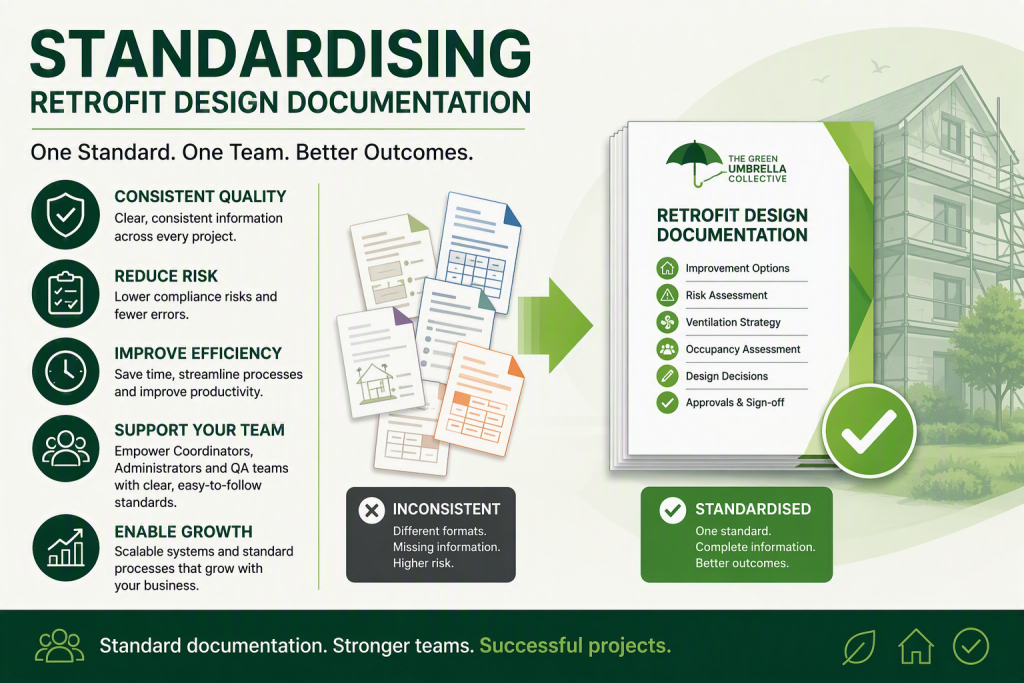
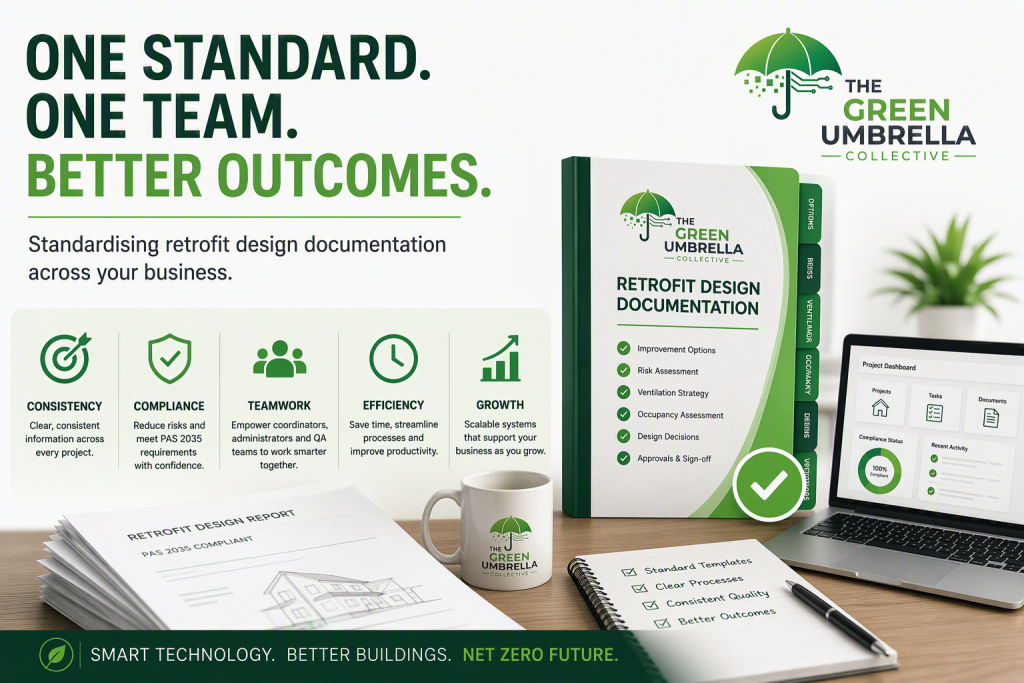
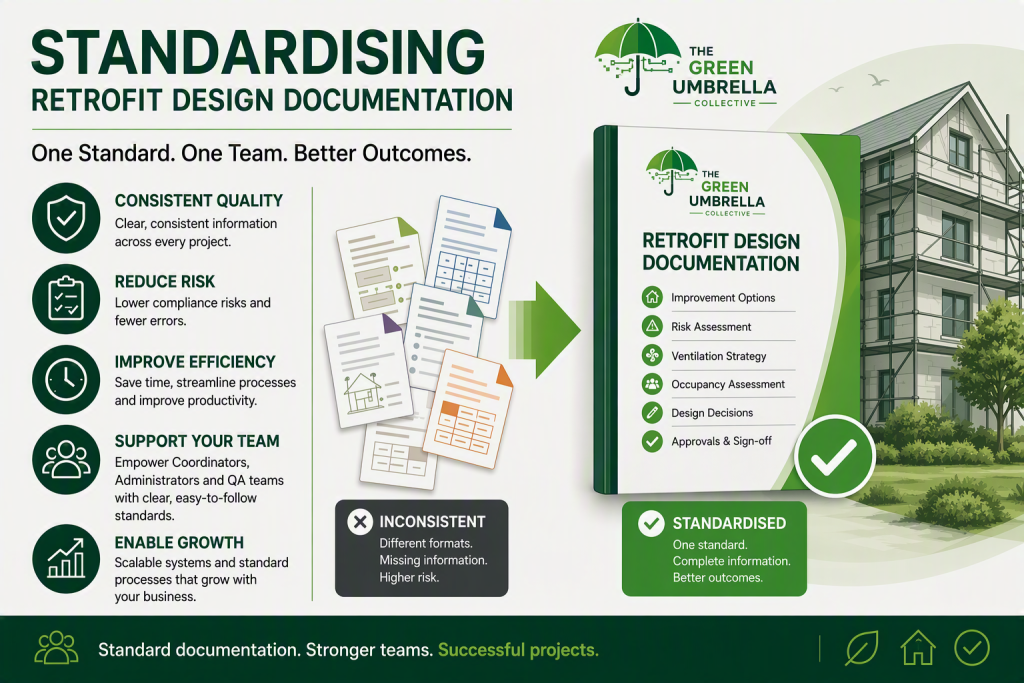
As retrofit businesses grow, one of the biggest challenges is maintaining consistency across multiple Retrofit Coordinators, Retrofit Assessors, designers and administrators. Every team member has their own way of presenting information, naming documents and recording decisions. Whilst this may seem like a minor issue, inconsistent documentation can lead to compliance risks, quality concerns and inefficiencies that impact project delivery. This is why you need standardised retrofit design documentation from Retrofit Design Pro
Consistency Creates Quality
A retrofit design should tell the same story regardless of who created it. If one coordinator presents improvement options in a different format, uses different terminology, or places key information in a different location within the report, it becomes more difficult for installers, quality assurance teams, clients and auditors to review.
Standardised documentation with Retrofit Design Pro ensures that:
- Improvement options are presented consistently.
- Risks are recorded in the same format.
- Ventilation requirements are clearly identified.
- Occupancy considerations are documented correctly.
- Sign-off and approval processes are followed uniformly.
The result is a higher quality output that reflects the company’s standards rather than an individual’s preferred working method.
Reducing Errors and Compliance Risks with Retrofit Design Pro
PAS 2035 projects generate significant amounts of information. Assessments, improvement option evaluations, medium-term improvement plans, ventilation calculations and design decisions must all align.
When documentation varies between team members, important information can be missed. Administrators may struggle to locate information required for lodgement. Quality assurance reviewers may spend excessive time checking reports. Auditors may identify inconsistencies that raise questions about the robustness of processes.
Standardisation reduces these risks by ensuring every retrofit design follows the same structure and contains the same required information.
Improving Efficiency
Many retrofit businesses rely on administrators to compile evidence, prepare lodgement packs and support Retrofit Coordinators.
If every coordinator produces documentation differently, administrators must spend time understanding individual preferences and searching for information. This creates unnecessary delays and increases training requirements.
A standardised document set means:
- Administrators know exactly where information should be found.
- New staff can be trained more quickly.
- QA checks are faster.
- Lodgements can be completed more efficiently.
- Work can be redistributed across the team without disruption.
Retrofit Design Pro becomes increasingly important as businesses scale and project volumes increase.
Supporting Internal Quality Assurance
Quality assurance reviews are significantly easier when every retrofit design follows a defined template and methodology.
Reviewers can focus on technical accuracy and compliance rather than spending time understanding different reporting styles. Common issues can be identified earlier, corrective actions can be implemented consistently and lessons learned can be shared across the organisation.
Ultimately, standardisation through Retrofit Design Pro creates a repeatable process that is easier to monitor, measure and improve.
Providing a Better Client Experience
Clients expect professional, consistent documentation. Housing associations, local authorities, installers and fund managers want confidence that projects are being managed through a controlled process.
When every report, design package and communication follows a common format, clients receive a more professional service and gain confidence in the organisation delivering the work.
Consistency demonstrates that the business has mature processes and strong governance arrangements rather than relying on individual knowledge.
The Role of Templates and Procedures
Achieving standardisation is not simply about using a template. It requires:
- Defined document templates.
- Clear naming conventions.
- Document control procedures.
- Version control processes.
- Internal training.
- Quality assurance reviews.
- Regular updates when standards and requirements change.
Everyone involved in the retrofit process should understand not only what information is required, but also how it should be presented.
Standardisation Enables Growth with Retrofit Design Pro
Many retrofit businesses start with one or two technical experts. As workloads increase, more coordinators, assessors and administrators are recruited. Without standardised systems, growth often creates inconsistency and increased compliance risk.
The organisations that scale successfully are those that develop documented processes, standard templates and controlled workflows that allow any competent team member to produce work to the same standard.
The goal is simple: the quality of a retrofit design should not depend on who created it. It should reflect the quality standards of the organisation itself.
For businesses delivering PAS 2035 projects, standardised documentation is not just an administrative exercise. It is a critical component of quality, compliance, efficiency and long-term growth.
For more information email us at hello@TGUC.co.ukn or call us on 0151 374 0044