Building a more connected digital journey from property assessment and PAS 2035 design through to installation and delivery
At The Green Umbrella Collective, we built Retrofit Design Pro around a simple observation: too much valuable time in retrofit is spent moving information between documents, templates and systems rather than using that information to make better decisions.
Producing a compliant retrofit design involves bringing together a significant amount of information. Assessment data, condition surveys, technical information, proposed measures, ventilation requirements, risks and design decisions all need to come together into one coherent output.
Retrofit Design Pro brings survey information, design decisions and client-ready documentation into a structured PAS 2035 workflow, using AI to extract and organise information, populate design sections and identify inconsistencies while keeping the designer in control of the final output.
But we have always believed the opportunity is bigger than producing a better design document.
The information within that design needs to remain useful when the project moves from design into delivery.
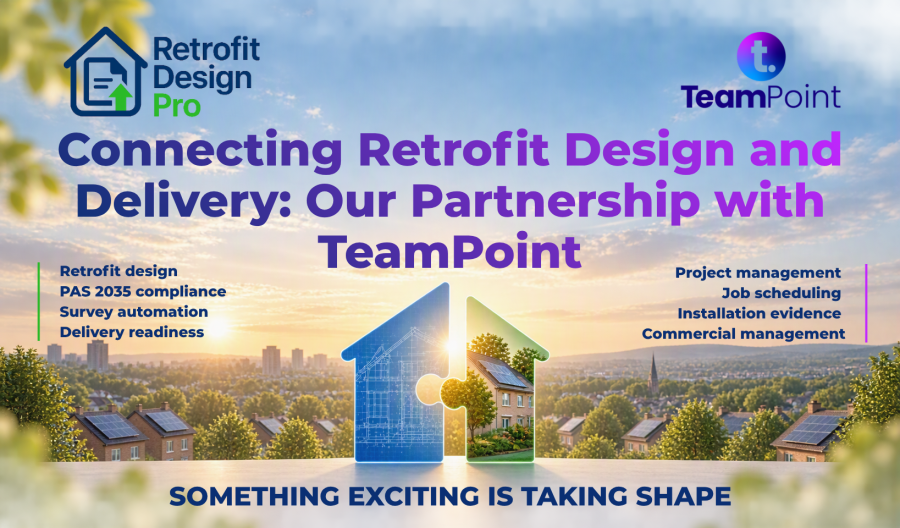
That is the thinking behind our partnership with TeamPoint.
Retrofit doesn’t stop when the design is signed off
Getting to an approved design is an important milestone, but it is not the end of the retrofit journey.
That design has to be translated into activity on the ground. Specifications need to be understood, products purchased, work scheduled, installers coordinated, changes managed and evidence captured.
And that’s where an industry-wide digital challenge becomes apparent.
The information required to deliver the project often already exists. The difficulty is that it can exist in a different document, platform or part of the process.
TeamPoint highlighted the same challenge from the delivery side. Its partnership article describes different stages of retrofit being managed in separate systems, requiring information to be transferred between them and creating duplicated work, disconnected records and opportunities for error.
We have been approaching that challenge from the other direction.
Building Retrofit Design Pro around the information, not the paperwork
The original focus for Retrofit Design Pro was removing unnecessary administration from PAS 2035 design.
Rather than repeatedly transferring information from RdSAP data and surveys into templates, the platform uses those source materials to help create a structured design workflow. Designers can then review, validate and refine that information before producing the final output.
Our platform has subsequently developed beyond design-document production.
Our current brochure describes both a Design Studio for developing PAS 2035 designs and a Delivery Hub for managing properties, tasks, workflow stages, readiness, compliance information and programme-level reporting.
That development reflects something we increasingly see as fundamental:
Retrofit shouldn’t be thought of as a collection of individual documents. It should be thought of as a connected flow of information around a property.
The assessment informs the design.
The design informs the installation.
What happens during installation creates new information and evidence.
And that information needs to support coordination, compliance, handover and reporting.
The less often that chain is broken, the more useful the underlying information becomes.
Why TeamPoint?
This is where our respective areas of expertise complement one another.
Retrofit Design Pro has been created specifically around retrofit assessment, PAS 2035 design and the information and decisions required to progress a property through that process.
TeamPoint approaches the problem from operational delivery. Its existing platform supports contractors with areas including scheduling installation teams, subcontractor coordination, purchasing, variations, project finances, site information and evidence collection.
So rather than trying to make one generic system do everything, we’re exploring something we think is much more interesting:
Two specialist platforms, connected around the same property and the same project.
Our shared ambition is for information from an approved retrofit design to be able to move into TeamPoint and support activities such as quotations, purchasing and installation jobs.
Then, as work progresses, information and evidence gathered during delivery could contribute back towards compliance records, customer handover information and business reporting.
The integration is still being developed. It isn’t an available feature today, and that distinction matters.
But the direction is clear.
From data entry to data flow
One of the principles behind Retrofit Design Pro has always been that if reliable information has already been captured, we should avoid asking a professional to type it all out again.
That’s why our software works with information including RdSAP XML, condition surveys, site information and supporting project data, extracting and organising useful inputs before the designer reviews them.
The partnership with TeamPoint takes that same principle further.
If information has already been captured and approved during retrofit design, why should the delivery team have to recreate it?
And in the other direction:
If good-quality information and evidence has already been captured during installation, how can we make better use of it throughout the rest of the retrofit process?
The goal isn’t integration for integration’s sake.
It’s reducing unnecessary duplication and creating a clearer connection between what was assessed, what was designed and what was actually delivered.
Keeping professional judgement where it belongs
We’re enthusiastic about automation and AI, but Retrofit Design Pro isn’t about removing the professional from retrofit design.
It’s about removing more of the repetitive work surrounding them.
Our own product material describes a workflow in which information can be extracted and organised automatically, while designers remain responsible for reviewing and validating the information and maintaining control of the final output.
We think the same philosophy should apply as digital technology connects more of the retrofit journey.
Automate movement of information where it makes sense.
Make gaps and inconsistencies easier to identify.
Give each professional the information they need to make their decision.
And maintain a clearer record as the project progresses.
Building this with the retrofit industry
Perhaps the most important part of the partnership is that we don’t want to decide what this integration should look like in isolation.
A technically elegant integration is of little value if it doesn’t reflect how retrofit is actually delivered.
That’s why we and TeamPoint are looking for retrofit businesses to help shape the next stage of development using real-world projects and workflows. TeamPoint is inviting early development partners specifically to help identify where processes work, where information gets lost between design and installation, and where better connections could make project management easier.
We want input from the people dealing with these challenges every day.
Where are you entering the same information twice?
Where does information stop flowing?
What does your delivery team need from the design that isn’t easily accessible today?
And what information generated during installation should be feeding back into your compliance and project records?
Those are the practical problems worth solving.
One property. One journey. Better-connected information.
There’s a lot still to develop, but the shared ambition behind the partnership is straightforward.
We want excellent specialist tools to work together so retrofit businesses don’t have to bridge the gaps between them manually.
For us, that’s also part of the wider ambition for Retrofit Design Pro: moving beyond making PAS 2035 design production faster and more consistent, towards making the information created during design more useful throughout the life of the project.
This reflects our broader ambition for Retrofit Design Pro: using smart technology to better connect PAS 2035 design and delivery, reduce unnecessary administration and ultimately support better buildings.
The partnership with TeamPoint is another step towards that ambition.
Two specialist platforms. Different strengths. One connected retrofit journey.
Interested in helping shape it?
If you’re a retrofit contractor, coordinator, designer, housing provider or programme delivery team and recognise the challenges we’re describing, we’d like to hear from you.
[Explore Retrofit Design Pro]
[Talk to us about becoming a development partner]
You can also read TeamPoint’s perspective on the partnership in Connecting Retrofit Design and Delivery: TeamPoint and Retrofit Design Pro.